

Kidney Cysts: Are They Dangerous and When Do They Need Treatment?
Kidney cysts are fluid-filled sacs that develop in or on the kidneys. They are relatively common, particularly as people get older, and many do not cause symptoms or require treatment. However, some kidney cysts may need further investigation, especially if they are large, complex, growing, or associated with pain or other urinary symptoms.
Understanding the different types of kidney cysts can help you recognize when medical evaluation is necessary. If you are searching for the best urologist in Agra for kidney-related concerns, consulting an experienced specialist can help you understand your diagnosis and available treatment options.
Dr. Dilip Kumar Mishra is a Consultant Urologist and Andrologist in Agra who evaluates and treats a range of urological conditions. This guide explains kidney cyst symptoms, causes, diagnosis, treatment options, and when you should seek medical advice.
What Is a Kidney Cyst?
A kidney cyst is a sac containing fluid that develops in or around the kidney. Kidney cysts can vary in size and appearance, and their significance depends on their characteristics and the patient’s overall health.
There are two broad categories:
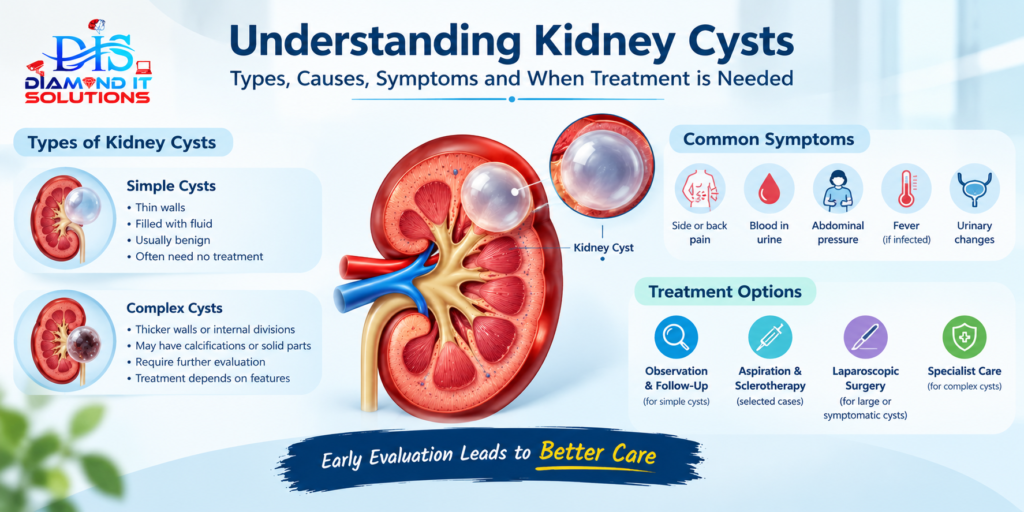
1. Simple kidney cysts
Simple cysts usually have thin walls and contain fluid. They are generally benign and are often discovered incidentally during an ultrasound or another imaging test. Most simple kidney cysts do not require treatment unless they cause symptoms or complications.
2. Complex kidney cysts
Complex cysts may have thicker walls, internal divisions, calcifications, or solid components. Some require additional imaging and specialist assessment to determine whether they pose a significant risk.
A complex cyst does not automatically mean cancer. Its appearance on appropriate imaging tests helps doctors decide whether monitoring, further investigation, or treatment is necessary.
What Causes Kidney Cysts?
The exact cause of many simple kidney cysts is not fully understood. Their likelihood increases with age, and they are often found during tests performed for unrelated medical reasons.
Factors and conditions associated with kidney cysts include:
- Age: Simple kidney cysts become more common as people grow older.
- Inherited conditions: Polycystic kidney disease is a genetic condition that can cause multiple cysts in the kidneys.
- Incidental findings: Kidney cysts may be detected during imaging performed for abdominal pain or other concerns.
- Underlying kidney conditions: Certain medical conditions require closer evaluation when cysts are present.
It is important to distinguish an isolated simple kidney cyst from an inherited condition such as polycystic kidney disease, as their management and follow-up requirements differ.
What Are the Symptoms of Kidney Cysts?
Most simple kidney cysts do not cause noticeable symptoms. However, a large cyst or one that develops complications may cause symptoms that require medical assessment.
Possible symptoms include:
- Pain or discomfort in the side, back, or upper abdomen.
- A feeling of pressure in the abdomen.
- Blood in the urine.
- Fever or pain if a cyst becomes infected.
- Urinary or kidney-related complications in certain cases.
These symptoms can also occur with other medical conditions, including kidney stones and urinary infections. Therefore, symptoms alone cannot confirm that a kidney cyst is responsible.
Seek urgent medical attention if you develop severe sudden pain, fever with significant side or back pain, or visible blood in your urine accompanied by other concerning symptoms.
Are Kidney Cysts Dangerous?
The answer depends on the type of cyst, its imaging features, and whether it causes symptoms or complications.
Most uncomplicated simple kidney cysts are benign and do not affect normal kidney function. They may only require observation when a doctor considers follow-up appropriate.
Some cysts, however, need further evaluation because they may be associated with:
- Bleeding within or around the cyst.
- Infection.
- Pressure on nearby structures.
- Obstruction affecting urine drainage.
- Imaging features that raise concern about a cystic kidney tumour.
Doctors may use a classification system, such as the Bosniak classification, to assess certain kidney cysts on contrast-enhanced CT or MRI scans. This helps guide decisions about surveillance, additional testing, or treatment.
Do not assume that every cyst is dangerous or that every cyst is harmless. The appropriate approach depends on the individual findings.
How Are Kidney Cysts Diagnosed?
Kidney cysts are commonly identified through imaging tests. Your doctor may recommend one or more of the following investigations.
1. Ultrasound
An ultrasound uses sound waves to create images of the kidneys. It is frequently used to identify simple cysts and assess their size and general appearance.
2. CT Scan
A CT scan provides more detailed images and may be recommended when a cyst has complex features or requires further assessment. A contrast-enhanced study may be needed depending on the clinical situation.
3. MRI Scan
An MRI can provide additional information about selected kidney cysts, particularly when further characterization is necessary or a CT scan is unsuitable.
4. Blood and Urine Tests
Blood tests may help assess kidney function, while urine tests can identify blood or other abnormalities. These tests do not independently determine whether a cyst is benign or malignant.
Your doctor will select investigations based on the cyst’s appearance, your symptoms, medical history, and overall health.
Kidney Cyst Treatment: What Are the Available Options?
Not every kidney cyst needs treatment. Management depends on the cyst’s characteristics, associated symptoms, and the risk identified through appropriate investigations.
1. Observation and Follow-Up
Simple cysts that do not cause symptoms often need no treatment. Depending on the findings, a doctor may recommend observation or periodic imaging.
Follow-up should be individualized rather than based on a fixed schedule for everyone.
2. Aspiration and Sclerotherapy
For selected symptomatic cysts, a specialist may consider draining the fluid using a needle under imaging guidance. A sclerosing agent may also be used to reduce the chance of the cyst refilling.
The suitability of this approach depends on the cyst’s features and location. It is not appropriate for every cyst, particularly those requiring further evaluation for possible malignancy.
3. Laparoscopic Cyst Treatment
Some large or persistently symptomatic simple cysts may be treated with a minimally invasive surgical procedure, often involving opening or removing part of the cyst wall to relieve pressure.
The decision depends on the patient’s symptoms, cyst anatomy, and response to other management options.
4. Specialist Management of Complex Cysts
Complex cysts may require additional imaging, structured surveillance, or surgery, depending on their classification and risk. If a cyst raises concern for cancer, the specialist will discuss appropriate diagnostic and treatment pathways.
Treatment decisions should always be made after reviewing the relevant imaging and clinical findings.
Can Kidney Cysts Be Prevented?
There is no proven way to prevent every type of kidney cyst, particularly age-related simple cysts and inherited cystic kidney conditions.
However, maintaining general kidney health is beneficial. Helpful habits include:
- Drinking adequate fluids according to your individual medical needs.
- Managing blood pressure and diabetes, if applicable.
- Avoiding unnecessary use of medications that can harm the kidneys.
- Attending recommended follow-up appointments.
- Seeking medical advice for persistent side or back pain, blood in the urine, or other concerning symptoms.
These measures support overall health but do not guarantee that kidney cysts will not develop.
When Should You Consult a Urologist for a Kidney Cyst?
Consider a specialist consultation if:
- An ultrasound or CT scan has identified a kidney cyst.
- Your report describes a complex cyst or suspicious imaging features.
- You experience persistent side or back pain.
- You have recurrent symptoms or suspected cyst-related complications.
- Your doctor has recommended additional imaging or specialist review.
- You have a family history of polycystic kidney disease.
If you are looking for the best urologist in Agra, choose a specialist who can assess your imaging reports, explain the significance of the findings, and recommend an appropriate management plan.
Consult Dr. Dilip Kumar Mishra for Urological Evaluation in Agra
Dr. Dilip Kumar Mishra is a Consultant Urologist and Andrologist in Agra with qualifications including MBBS, MS, MRCS (Edinburgh, UK), MCh (Urology), FRLS (Japan), and FICS (USA).
For patients concerned about kidney cysts or other urinary tract conditions, a specialist consultation can help determine whether observation, further investigations, or treatment may be appropriate.
Consultation details:
Doctor: Dr. Dilip Kumar Mishra
Speciality: Consultant Urologist & Andrologist
Clinic 1: Urocare & Child Clinic
H. No. 24, Bhawna Estate, Babarpur Road, next to Nukkad Cafe, near Holy Public School, Sikandra, Agra, Uttar Pradesh – 282007.
Clinic 2: Yatharth Hospital
610, Kakretha Road, NH-19, near Guru Ka Taal, Agra, Uttar Pradesh.
Appointment contact numbers:
9758278670 | 9758278671
Google profile: https://share.google/9eaOD0W2LxcxZQ00q
If you have recently received an ultrasound, CT, or MRI report showing a kidney cyst, bring the report and any previous imaging to your consultation.
Frequently Asked Questions About Kidney Cysts
1. Are kidney cysts usually cancerous?
Most simple kidney cysts are benign. Complex cysts may need further evaluation because some have a higher risk of malignancy. Imaging characteristics and specialist assessment help determine the appropriate next steps.
2. Can a kidney cyst disappear on its own?
Many simple kidney cysts remain stable for years. They do not usually disappear completely without intervention, although their size and appearance can vary.
3. Does every kidney cyst require surgery?
No. Most simple kidney cysts do not need surgery. Treatment is generally considered when a cyst causes significant symptoms, complications, or has features that require intervention.
4. Can kidney cysts affect kidney function?
Most simple cysts do not significantly affect kidney function. Large cysts, multiple cysts, inherited cystic conditions, or associated complications may require closer monitoring.
5. Which scan is best for diagnosing a kidney cyst?
Ultrasound is commonly used to identify simple cysts. CT or MRI may be recommended when a cyst has complex features or needs further characterization.
6. When should I see a urologist for a kidney cyst in Agra?
Consult a urologist if your scan shows a complex cyst, you have persistent pain or other concerning symptoms, or your doctor recommends further evaluation. Sudden severe pain or fever with side pain warrants urgent medical assessment.
Conclusion
Kidney cysts are common, and most simple cysts are harmless. However, understanding the type of cyst and recognizing when further investigation is necessary are important for appropriate care.
If you have been diagnosed with a kidney cyst, do not panic or ignore the finding. Seek medical advice to understand your report and determine whether observation, additional testing, or treatment is appropriate.
For a urological consultation in Agra, contact Dr. Dilip Kumar Mishra at Urocare & Child Clinic or Yatharth Hospital using the appointment numbers provided above.
