
Advanced Kidney Stone Treatment in Agra: A Patient’s Guide to Modern Options
Kidney stone pain can interrupt sleep, work and everyday activities. Treatment depends on the stone’s size, location and effect on urine flow. Today, advanced kidney stone treatment in Agra includes options that use flexible scopes, lasers and small surgical openings.
If you are searching for the best urologist in Agra, a consultation with Dr. Dilip Kumar Mishra can help you understand which approach suits your condition. His published hospital profile lists RIRS, PCNL, Mini-PCNL and laser stone surgery among his special interests.
Recognising Kidney Stone Symptoms
Common kidney stone symptoms include pain in the back or side, pain spreading towards the groin, blood in urine, nausea and discomfort while urinating. Some people also notice frequent urination.
Seek urgent medical care for fever or chills with stone symptoms, severe uncontrolled pain, persistent vomiting or difficulty passing urine. These problems need prompt assessment rather than waiting for a routine appointment.
How Kidney Stones Are Evaluated
Before recommending kidney stone treatment in Agra, a urologist reviews your symptoms, previous stones, medical history and medicines. Urine tests can identify blood or signs of infection. Blood tests help assess kidney function and relevant mineral levels.
Imaging shows the stone’s size, position and whether urine flow is blocked. Depending on your circumstances, ultrasound or a non-contrast CT scan may be recommended. Bring earlier scans and prescriptions to your appointment. This helps the doctor compare findings and explain whether observation, medication or stone removal is appropriate.
Modern Kidney Stone Treatment Options
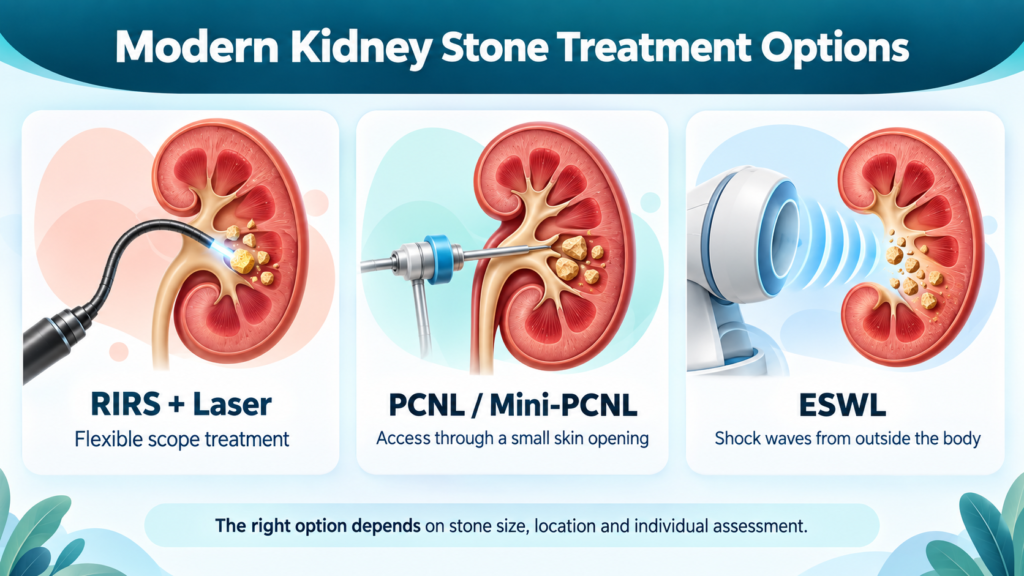
RIRS: Treatment Through the Natural Urinary Passage
Retrograde intrarenal surgery (RIRS) uses a flexible ureteroscope passed through the urethra, bladder and ureter into the kidney. The doctor views the stone and may use a laser to break it into smaller fragments.
RIRS requires no external skin incision, although it remains a surgical procedure, usually performed under general anaesthesia. A temporary ureteral stent may be placed to help drainage. Some patients need more than one treatment session.
People considering RIRS surgery in Agra should ask about suitability, risks and the stent removal plan.
Laser Lithotripsy: Breaking Stones Into Smaller Pieces
During laser lithotripsy, laser energy breaks a stone into fragments or fine particles, sometimes called “dusting.” Fragments may be retrieved, flushed out or passed afterwards.
Holmium and thulium fibre lasers are technologies used in modern stone treatment. The choice depends on available equipment, the stone and the surgeon’s assessment. Neither technology guarantees complete clearance in every case. When discussing kidney stone laser treatment in Agra, ask which system is proposed and why.
PCNL and Mini-PCNL for Larger Stones
Percutaneous nephrolithotomy (PCNL) allows the surgeon to reach the kidney through a small opening in the skin and remove stones using specialised instruments. It is commonly considered for larger or complex kidney stones, including stones around two centimetres or more.
Mini-PCNL uses a smaller access tract and instruments. In selected patients, this can reduce blood loss compared with standard PCNL. However, the appropriate approach depends on stone size, kidney anatomy and other health factors.
Patients exploring PCNL surgery in Agra or Mini-PCNL in Agra should discuss bleeding, infection, hospital stay and possible additional treatment.
ESWL: Using Shock Waves From Outside the Body
Extracorporeal shock wave lithotripsy (ESWL) uses shock waves generated outside the body to break suitable stones into smaller pieces. These fragments then pass through the urinary tract.
ESWL may suit selected patients, but stone size, location and hardness affect the decision. Repeat sessions or another procedure may be necessary.
Suction-Assisted Stone Treatment
Newer suction-assisted ureteroscopy techniques combine endoscopic treatment with systems that help remove stone dust and fragments. These devices can also help manage fluid outflow during surgery.
Their use depends on the equipment available and clinical suitability. Ask your treating team whether suction assistance is relevant to your planned procedure.
Recovery After Kidney Stone Surgery
Recovery varies with the procedure, stone burden and your health. Some patients go home on the day of ureteroscopy, while PCNL may require a longer stay.
Temporary discomfort, urinary urgency or blood in urine can occur, particularly with a stent. Follow your discharge instructions, take prescribed medicines and attend follow-up visits. If a stent is inserted, confirm when and how it will be removed. Also ask how the team will confirm that remaining fragments have cleared after treatment. Report fever, worsening pain or difficulty urinating promptly.
Preventing Recurrent Kidney Stones
Removing a stone does not eliminate the possibility of another one forming. Kidney stone prevention starts with understanding the stone type and your individual risk factors.
Ask about a suitable daily fluid target and dietary advice. Reducing excess salt and adjusting animal protein or oxalate intake may help particular stone types. Avoid cutting out dietary calcium without medical advice. Stone analysis and, when appropriate, a 24-hour urine test can guide a personalised prevention plan.
Frequently Asked Questions
Does every kidney stone need surgery?
No. Some smaller stones can pass with monitoring and symptom treatment. Persistent pain, blockage, infection or other concerns may make intervention necessary.
Is laser kidney stone treatment painless?
Anaesthesia controls pain during surgery. Discomfort can occur afterwards, especially with a stent. Your care team will explain pain management and recovery expectations.
Can kidney stones return after treatment?
Yes. Follow-up, hydration guidance and prevention based on stone analysis can help reduce recurrence risk.
Consult Dr. Dilip Kumar Mishra in Agra
Choosing advanced kidney stone treatment in Agra starts with an individual assessment. If you are looking for the best urologist in Agra, discuss your reports, treatment alternatives and recovery needs with Dr. Dilip Kumar Mishra.
Dr. Dilip Kumar Mishra
Qualifications: MBBS, MS, MRCS (Edinburgh, UK), MCh (Urology), FRLS (Japan), FICS (USA).
Urocare & Child Clinic:
Bhawna Estate, H. No. 24, Babarpur Road, next to NUKKAD CAFE, near Holy Public School, Sikandra, Agra, Uttar Pradesh 282007.
Additional consultation location:
Yatharth Hospital, 610, Kakretha Road, NH 19, near Guru ka Taal, Agra.
Appointments: 9758278670 / 9758278671
Website: drdilipmishraurologist.com
Call to confirm the consultation location and current timings before visiting.
