
Testicular Pain: Common Causes & When It Needs Medical Attention
Testicular pain is a symptom that many men may feel uncomfortable discussing, but it should not be ignored. Pain may occur in one or both testicles and can range from a mild, dull ache to sudden and severe discomfort.
While some causes of testicular pain are relatively minor, others—particularly testicular torsion—can require urgent medical treatment. Understanding the possible causes and warning signs can help you know when to consult a Urologist in Agra.
What Is Testicular Pain?
Testicular pain refers to discomfort felt in or around one or both testicles. Sometimes, the problem originates within the scrotum itself, while in other cases pain may be referred from another area, such as the groin, abdomen, or urinary tract.
The pain may be:
- Sudden or gradual
- Mild, moderate, or severe
- Constant or intermittent
- Associated with swelling or tenderness
- Present on one side or both sides
The pattern of pain can provide useful information, but proper medical evaluation is often necessary to identify the exact cause.
Common Causes of Testicular Pain
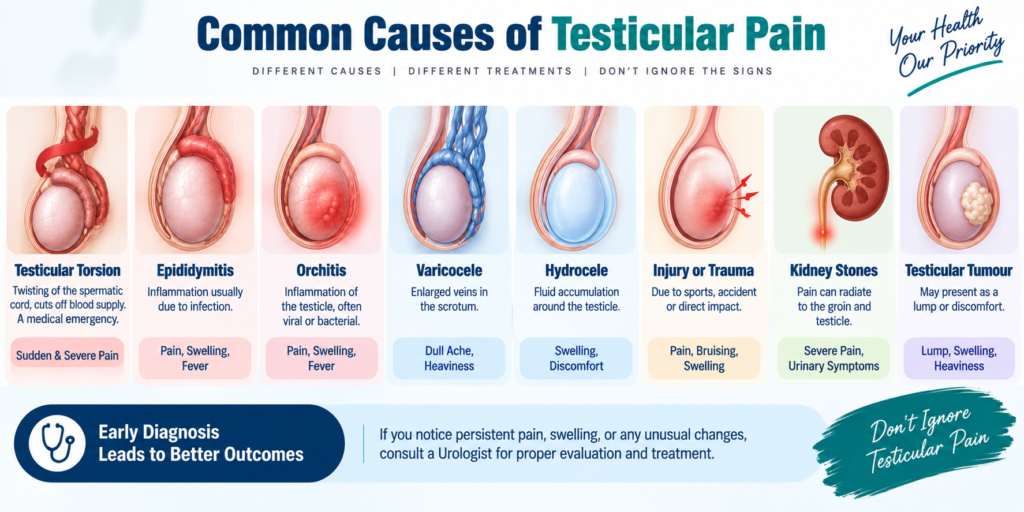
1. Testicular Torsion
Testicular torsion is one of the most important causes of sudden testicular pain. It occurs when the spermatic cord twists and reduces or cuts off blood flow to the testicle.
Possible symptoms include:
- Sudden and severe pain
- Swelling of the scrotum
- One testicle appearing higher than the other
- Nausea or vomiting
- Abdominal discomfort
Testicular torsion is a medical emergency. Prompt treatment is important because prolonged loss of blood supply can permanently damage the affected testicle.
If sudden, severe testicular pain develops, seek emergency medical care rather than waiting for the pain to improve on its own.
2. Epididymitis
The epididymis is a coiled tube located behind the testicle. Inflammation of this structure is known as epididymitis and is another common cause of scrotal pain.
Symptoms can include:
- Gradually increasing testicular pain
- Swelling and tenderness
- Warmth or redness of the scrotum
- Pain or burning while urinating
- Increased urinary frequency
- Fever in some cases
Epididymitis can have infectious and non-infectious causes. Treatment depends on the underlying reason.
3. Orchitis
Orchitis is inflammation of one or both testicles and may sometimes occur together with epididymitis.
It can cause:
- Testicular pain
- Swelling
- Tenderness
- Fever
- General discomfort
A urologist may recommend investigations to determine the cause before deciding on treatment.
4. Injury or Trauma
A direct injury during sports, exercise, an accident, or other physical activity can cause temporary testicular pain and swelling.
Mild discomfort may improve, but significant trauma accompanied by severe pain, persistent swelling, bruising, or worsening symptoms should be medically evaluated.
5. Varicocele
A varicocele occurs when veins inside the scrotum become enlarged. It commonly develops on the left side and may cause a dull or dragging sensation rather than sudden severe pain.
Symptoms can include:
- Dull aching pain
- Feeling of heaviness in the scrotum
- Pain that becomes worse after standing for long periods
- Enlarged or prominent veins
- Possible fertility problems in some men
Not every varicocele requires treatment. Management depends on symptoms, testicular health, and fertility considerations.
6. Hydrocele
A hydrocele occurs when fluid accumulates around a testicle.
It usually causes painless swelling, but some people may experience discomfort or a feeling of heaviness, particularly when the swelling becomes larger.
A clinical examination and ultrasound may help differentiate a hydrocele from other causes of scrotal swelling.
7. Inguinal Hernia
An inguinal hernia occurs when tissue protrudes through a weak area in the abdominal wall near the groin.
In some cases, the hernia can extend toward the scrotum and cause:
- Groin discomfort
- Scrotal pain or heaviness
- A visible or palpable bulge
- Symptoms that worsen with lifting, coughing, or physical activity
Sudden severe pain associated with a hernia requires urgent medical evaluation.
8. Kidney Stones
Interestingly, pain felt in the testicle does not always originate there.
A kidney or ureteric stone may cause pain that travels from the back or side toward the groin and testicle. This is known as referred pain.
Other symptoms may include:
- Severe pain in the back or side
- Pain radiating toward the groin
- Blood in urine
- Nausea or vomiting
- Urinary discomfort
9. Testicular Tumour
Testicular cancer more commonly presents as a painless lump or swelling rather than pain. However, some patients may experience discomfort, heaviness, or an ache in the testicle or scrotum.
Any new lump, change in size, persistent swelling, or unusual firmness of a testicle should be evaluated by a doctor.
When Does Testicular Pain Need Immediate Medical Attention?
Certain symptoms should not be ignored.
Seek urgent medical attention if you experience:
- Sudden and severe testicular pain
- Rapid swelling of the scrotum
- Testicular pain accompanied by nausea or vomiting
- A testicle appearing unusually high or positioned differently
- Severe pain following an injury
- Significant redness, swelling, or fever
- Severe pain that does not improve
Sudden severe testicular pain can indicate testicular torsion, where rapid diagnosis and treatment are particularly important.
When Should You Consult a Urologist?
You should consider consulting a Urologist in Agra if:
- Testicular pain persists or keeps returning
- You notice swelling or a lump
- There is a feeling of heaviness in the scrotum
- Pain occurs along with urinary symptoms
- You have fever with testicular discomfort
- One testicle appears different in size or shape
- Pain affects your normal activities
Avoid self-diagnosing the cause based only on symptoms, because several testicular conditions can produce similar signs.
How Is Testicular Pain Diagnosed?
Diagnosis generally begins with a detailed medical history and physical examination.
Depending on the suspected cause, the doctor may recommend:
Scrotal Ultrasound
Ultrasound can help examine the testicles, epididymis, blood flow, fluid collections, and other abnormalities.
Urine Tests
Urine analysis or culture may be recommended when a urinary or bacterial infection is suspected.
Blood Tests
Blood investigations may help identify signs of infection or inflammation.
Additional Investigations
Other tests may be recommended depending on symptoms and clinical findings.
Treatment for Testicular Pain
There is no single treatment for all cases of testicular pain because treatment depends entirely on the underlying cause.
Management may include:
- Appropriate pain-relieving medicines
- Antibiotics when a bacterial infection is confirmed or strongly suspected
- Scrotal support in selected conditions
- Treatment of kidney or urinary tract problems
- Management of varicocele or hydrocele when clinically indicated
- Surgical treatment for certain conditions
- Emergency surgery for testicular torsion
Self-medication should be avoided, particularly when the cause of pain has not been diagnosed.
Can Testicular Pain Be Prevented?
Not every cause can be prevented, but some practical measures may reduce the risk of injury or complications.
Consider:
- Wearing appropriate protective gear during contact sports
- Seeking treatment for urinary or genital infections
- Avoiding unnecessary delay when pain or swelling develops
- Performing periodic awareness checks for unusual lumps or changes
- Consulting a urologist when symptoms persist
Don’t Ignore Persistent Testicular Pain
Testicular pain can have many possible causes—from minor injury and inflammation to conditions requiring urgent treatment.
Most importantly, sudden and severe testicular pain should be treated as a medical emergency until a healthcare professional determines the cause.
Persistent pain, swelling, a lump, or changes in the testicle should also be evaluated rather than ignored.
Consult Dr. Dilip Kumar Mishra – Urologist in Agra
For evaluation and treatment of testicular pain, urinary problems, kidney conditions, prostate disorders, and other urological concerns, you can consult:
Dr. Dilip Kumar Mishra
MBBS, MS, MRCS (Edinburgh, UK)
MCh (Urology), FRLS (Japan), FICS (USA)
Urocare & Child Clinic
Bhawna Estate, H. No. 24, Babarpur Road, next to Nukkad Cafe, near Holy Public School, Sikandra, Agra, Uttar Pradesh – 282007
Yatharth Hospital
610, Kakretha Road, NH-19, Near Guru Ka Taal, Agra
For Appointments:
9758278670
9758278671
If you are experiencing persistent testicular pain, swelling, or other urological symptoms, timely evaluation can help identify the cause and determine the appropriate treatment.
